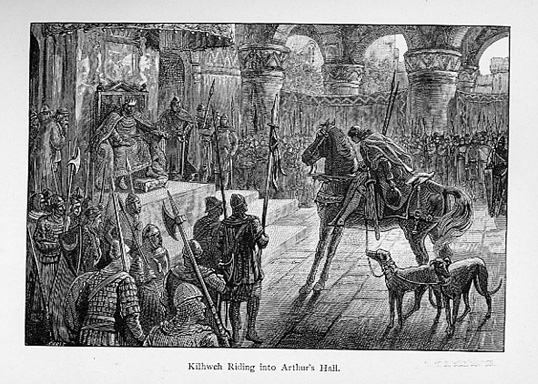
The Folk Culture of Wales is a rich and historic treasure, going all the way back to the stories of King Arthur’s Court. Although it’s not clear that Arthur was even considered a king, a number of ancient Welsh texts refer to him as Penteyrnedd yr Ynys hon, “Chief of the Lords of this Island”, the overlord of Wales, Cornwall and the North. Recent scholarship shows that the legend of King Arthur may have actually been based on a real Romano-British leader that fought against the invading Anglo-Saxons, sometime in the late 5th to early 6th century. (Source: Wikipedia, Pre-Galfridian traditions)
But Wales has plenty of contemporary folk traditions too. Hen Wlad Fy Nhadau (Old Land of My Fathers) has served as an unofficial Welsh anthem since 1905, when it became a popular song with fans at rugby games. But the song was written decades earlier—by James James, a harpist who played his instrument in the public house he ran—for the purpose of dancing. The song, originally entitled Glan Rhondda (Banks of the Rhondda), was first performed in the vestry of the original Capel Tabor, Maesteg (which later became a working men’s club), in either January or February 1856, by Elizabeth John from Pontypridd, and it soon became popular in the locality. (Sources: Wikipedia, National Anthem; Wikipedia, Origins)
Hen Wlad Fy Nhadau
If you’re looking for more Welsh folk culture, one great resource to find many traditional Cambrian songs and stories is Amgueddfa Cymru (National Museum Wales). The museum has done an excellent job curating several beautiful folk songs and folk tales.
 Old Salem Church